
Ingredients

200 g sourdough starter
800 g flour (half all-purpose flour and half whole wheat flour)
400 ml lukewarm water
2 teaspoons salt
2 tablespoons olive oil

Note: if you use tap water, it is necessary to boil it and let it cool before using it. The chlorine kills all bacteria useful for the leavening. As an alternative you may also use bottled water.

Directions

In a food processor, combine the sourdough with 700 g flour and 300 ml of lukewarm water. Knead the mixture for at least 10 minutes, until it changes consistency and it doesn’t stick to the walls of the bowl.
Once done, do not forget to put 2 tablespoons of sourdough on the side to keep in the fridge for the following bread!
Keep the dough at a temperature of around 30°C for about two hours until the volume of the dough is doubled. In winter make it rise in the oven with the help of the warmth of the oven lamp.
Melt the salt in the remaining water; add it to the dough with the olive oil and the rest of the flour. Knead it for another 5 minutes by hand or with the food processor. The dough should look compact and solid.
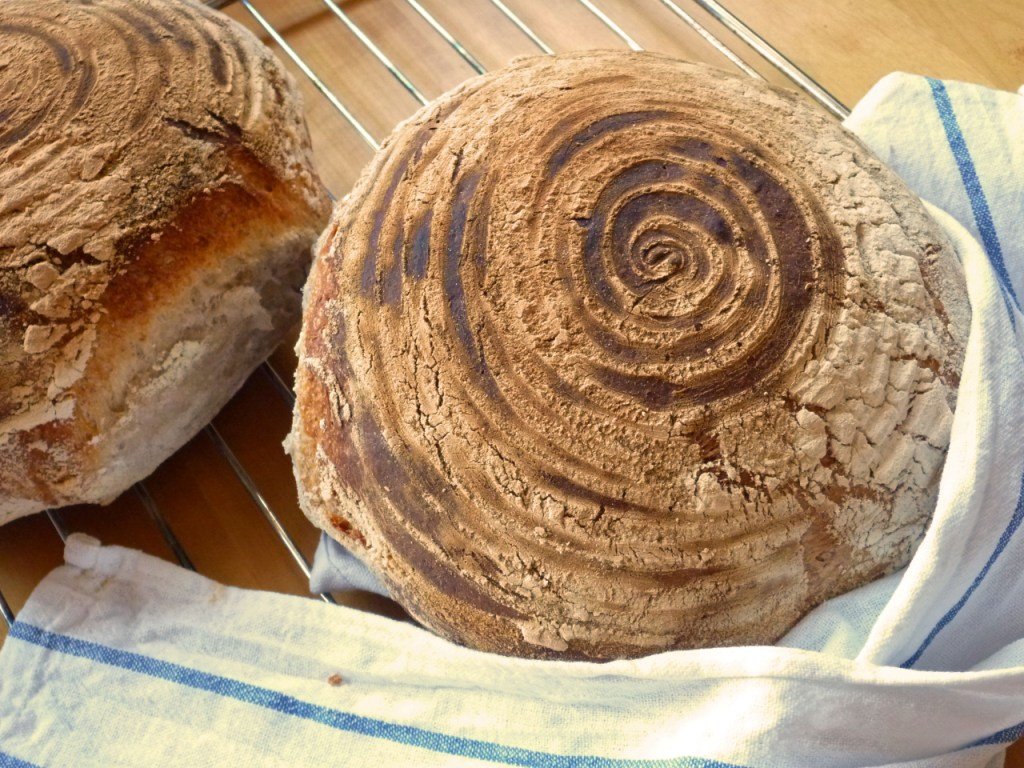
Divide the dough in two parts and put them in two bowls covered in flour. (There are also containers made specifically for dough fermentation which leave a stamp like a pretty spiral.)
Now the bread will need time to rise: cover it with a clean cloth, and let it rise at the same 30˚ C temperature. Give it 4-5 hours.
Once this is done, add the loaves to a baking tray covered by baking paper. Let it rest for another hour to allow the bread to take its form.
Meanwhile heat the oven to 230°C and place a bowl of water on the bottom of the oven. Bake the bread for about 50 minutes.
Now your home will remind you of your childhood memories and your mouth will water!


Zutaten

200 g Sauerteig-Ansatz (selbstgemacht oder gekauft)
800 g Mehl (halb Weissmehl und halb Weizenvollkornmehl)
400 ml lauwarmes Wasser
2 TL Salz
2 EL Olivenöl

Beachte: Leitungswasser zuvor abkochen und abkühlen lassen. Das Chlor schadet den Bakterien, die für das Gehen des Teiges verantwortlich sind. Man kann auch Wasser aus der Flasche verwenden.


Zubereitung

In der Küchenmaschine 700 g Mehl, 300 ml Wasser und den Sauerteig mindestens 10 Min. zu einem Teig kneten, bis der Teig seine Konsistenz ändert und nicht mehr an der Schüssel klebt.
Daran denken, 2 EL dieser Teigmischung entnehmen und im Kühlschrank für das nächste Brot aufbewahren.
Den Teig bei ungefähr 30°C etwa 2 Stunden ruhen lassen, bis sich das Volumen verdoppelt hat. Im Winter kann man den Teig in den Ofen stellen und mit Hilfe der Ofenlampe warm halten.
Salz im restlichen Wasser auflösen; zum Teig geben, Olivenöl und das restlichen Mehl hinzufügen. Weitere 5 Min. von Hand oder in der Küchenmaschine kneten. Der Teig sollte kompakt und fest aussehen.
Den Teig in 2 Teile teilen und jeweils in eine Schüssel legen, mit Mehl abdecken. (Es gibt auch Behälter speziell zur Fermentierung von Brot, die ein hübsches Muster auf der Unterseite hinterlassen.)
Jetzt muss das Brot nochmals gehen: mit einem sauberen Tuch abdecken und bei 30°C 4-5 Stunden gehen lassen.
Anschließend die Laibe auf ein mit Backpapier belegtes Backblech legen. Eine weitere Stunde ruhen lassen, damit das Brot seine Form annehmen kann.
Inzwischen den Backofen auf 230°C vorheizen und eine Schale mit Wasser auf den Boden des Ofens stellen. Das Brot ungefähr 50 Min. backen.

Ingredients

200 g sourdough starter
800 g flour (half all-purpose flour and half whole wheat flour)
400 ml lukewarm water
2 teaspoons salt
2 tablespoons olive oil

Note: if you use tap water, it is necessary to boil it and let it cool before using it. The chlorine kills all bacteria useful for the leavening. As an alternative you may also use bottled water.

Directions

In a food processor, combine the sourdough with 700 g flour and 300 ml of lukewarm water. Knead the mixture for at least 10 minutes, until it changes consistency and it doesn’t stick to the walls of the bowl.
Once done, do not forget to put 2 tablespoons of sourdough on the side to keep in the fridge for the following bread!
Keep the dough at a temperature of around 30°C for about two hours until the volume of the dough is doubled. In winter make it rise in the oven with the help of the warmth of the oven lamp.
Melt the salt in the remaining water; add it to the dough with the olive oil and the rest of the flour. Knead it for another 5 minutes by hand or with the food processor. The dough should look compact and solid.
Divide the dough in two parts and put them in two bowls covered in flour. (There are also containers made specifically for dough fermentation which leave a stamp like a pretty spiral.)
Now the bread will need time to rise: cover it with a clean cloth, and let it rise at the same 30˚ C temperature. Give it 4-5 hours.
Once this is done, add the loaves to a baking tray covered by baking paper. Let it rest for another hour to allow the bread to take its form.
Meanwhile heat the oven to 230°C and place a bowl of water on the bottom of the oven. Bake the bread for about 50 minutes.
Now your home will remind you of your childhood memories and your mouth will water!


Ingredients

200 g sourdough starter
800 g flour (half all-purpose flour and half whole wheat flour)
400 ml lukewarm water
2 teaspoons salt
2 tablespoons olive oil

Note: if you use tap water, it is necessary to boil it and let it cool before using it. The chlorine kills all bacteria useful for the leavening. As an alternative you may also use bottled water.

Directions

In a food processor, combine the sourdough with 700 g flour and 300 ml of lukewarm water. Knead the mixture for at least 10 minutes, until it changes consistency and it doesn’t stick to the walls of the bowl.
Once done, do not forget to put 2 tablespoons of sourdough on the side to keep in the fridge for the following bread!
Keep the dough at a temperature of around 30°C for about two hours until the volume of the dough is doubled. In winter make it rise in the oven with the help of the warmth of the oven lamp.
Melt the salt in the remaining water; add it to the dough with the olive oil and the rest of the flour. Knead it for another 5 minutes by hand or with the food processor. The dough should look compact and solid.
Divide the dough in two parts and put them in two bowls covered in flour. (There are also containers made specifically for dough fermentation which leave a stamp like a pretty spiral.)
Now the bread will need time to rise: cover it with a clean cloth, and let it rise at the same 30˚ C temperature. Give it 4-5 hours.
Once this is done, add the loaves to a baking tray covered by baking paper. Let it rest for another hour to allow the bread to take its form.
Meanwhile heat the oven to 230°C and place a bowl of water on the bottom of the oven. Bake the bread for about 50 minutes.
Now your home will remind you of your childhood memories and your mouth will water!